


 Українська
 Русский
What is thermal wood: features, properties and types of heat treatment
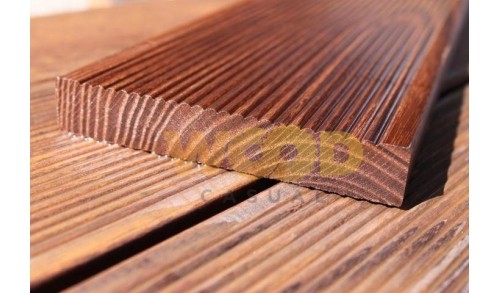
Thermal wood is wood that has undergone special treatment at high temperatures to improve its operational properties. This process is called heat treatment, and it allows you to significantly increase the resistance of wood to external factors such as moisture, fungus and insects. But what exactly is thermal wood, what are its features and properties, and what types of heat treatment are there? Let's consider these questions in more detail.
What is thermal wood?
Thermowood is a material obtained by processing wood at high temperatures (from 160 to 240°C) in an oxygen-free environment. This process changes the structure of the wood, making it more resistant to environmental influences. Thanks to heat treatment, wood becomes less susceptible to decay, reduces moisture absorption, and also acquires improved thermal insulation properties.
Features of thermal wood
One of the main features of thermal wood is its environmental friendliness. No chemicals are used for processing, the process is based on the action of high temperature and water vapor. This makes thermal wood safe for human health and suitable for use in residential premises.
Another important feature is improved resistance to moisture. During heat treatment, a large amount of moisture is removed from wood, and the cell structure changes, which reduces the material's ability to absorb water. This makes thermal wood an ideal choice for use in outdoor spaces such as terraces, garden furniture or house cladding.
Thermowood properties
Thermal wood has a number of unique properties that distinguish it from traditional wood.
Rotting resistance. Thanks to heat treatment, the amount of sugars in wood, which are the main source of food for fungi and insects, is reduced. This significantly extends the service life of the material.
Reduction of deformations. After heat treatment, the wood becomes more stable and less prone to expansion or contraction under the influence of changes in humidity and temperature.
Improved thermal insulation properties. Thermowood has a lower thermal conductivity compared to untreated wood, which makes it an effective heat insulator.
Aesthetics. Under the influence of high temperature, wood changes color - it acquires a darker, more saturated shade, which adds to its decorative value.

Types of heat treatment
Heat treatment can be carried out using several technologies that differ in temperature regimes and processing conditions. Here are the main types of heat treatment.
Low-temperature processing (160–180°C). This type of heat treatment only partially improves the properties of wood. It becomes less sensitive to moisture, but its level of rot resistance remains average.
Medium temperature treatment (180–210°C). Wood acquires more pronounced properties of heat resistance, its water absorption decreases and resistance to fungi and insects increases.
High-temperature processing (210–240°C). The most effective type of processing. Wood after this process becomes extremely resistant to moisture and decay, but its strength decreases and it becomes more brittle.
Types of thermal wood
Depending on the type of wood and the level of heat treatment, thermal wood can have different properties. The most common types of thermal wood are:
Thermal pine. One of the most popular types of thermal wood due to availability and good operational properties. Thermal pine has a pleasant dark yellow color and high resistance to moisture.
Thermal ash This type of thermal wood is valued for its strength and pronounced texture. It is used in construction and for the production of floor coverings.
Application of thermowood
Thermal wood is actively used in construction and interior design. Due to its unique properties, it is ideal for outdoor use: facades, terraces, garden furniture, decking near swimming pools. Thermowood is also used for interior decoration of premises, as it does not emit harmful substances and has an attractive appearance.
In addition, thermal wood is popular in the production of furniture, in particular for wet rooms such as bathrooms and baths, where ordinary wood deteriorates quickly due to high humidity. Thermal wood retains its properties even in such conditions.
14/10/2024