


 Українська
 Русский
Wood drying: methods and advantages
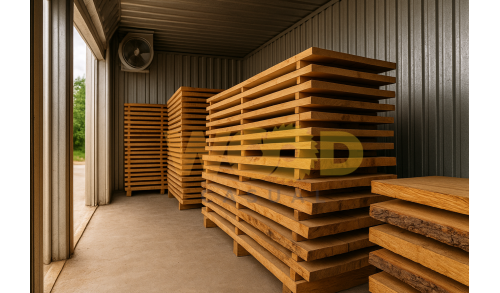
Preparing wood for use begins with its proper drying. Regardless of whether it is construction, finishing or furniture production, the strength, shape stability and service life of the product depend on the quality of drying. In this article, we will analyze what wood drying is, what types of drying exist, and what technologies are used to achieve the best result.
Why do we need to dry wood?
Freshly cut wood contains a large percentage of moisture - sometimes over 50%. Such humidity makes the material vulnerable to mold, fungus and deformation. This is why wood drying is necessary - to bring the humidity to a safe level (usually 8-12%) and ensure geometric stability.
Wood drying is a process of gradually removing excess moisture from the structure of wood fibers. The goal is to make the material suitable for use in dry conditions without the risk of shrinkage, warping or cracking.
Main methods of drying wood
There are various methods of drying wood, each of which has its own characteristics, advantages and limitations. Below we will consider the most common types of wood drying.
1. Atmospheric (natural) drying
This is the simplest and most accessible method, especially when it comes to drying wood at home. The blanks are stacked under a ventilated canopy, where the material dries due to natural air exchange.
Advantages:
minimal costs;
no equipment required.
Disadvantages:
long drying time for wood (from several months to a year);
unpredictable result;
risk of damage by microorganisms.
2. Drying chambers
This method uses the technology of drying wood in a drying chamber, where the parameters (humidity, temperature, ventilation) are carefully controlled. The drying temperature of wood varies from 50 to 90 ° C depending on the type and thickness of lumber.
Advantages:
precise humidity control;
uniform drying;
high speed - fast drying of wood can take from 3 to 15 days.
Disadvantages:
energy costs;
experience and equipment required.
3. Vacuum drying
Drying wood in a vacuum is a modern technology that allows you to speed up the process and preserve the geometry of the material. Due to the reduced pressure, water evaporates at a lower temperature, which reduces internal stress in the wood.
Advantages:
minimal deformations;
fast drying (up to 2-4 times faster than traditional chamber drying);
high-quality drying of capricious species.
Disadvantages:
high cost of equipment;
small volumes per cycle.
Methods and technologies: how to choose the right one
Wood drying technology is selected based on quality requirements, wood species, budget and available resources. There are several methods of drying wood, including:
Convective - the most popular, based on the circulation of heated air;
Infrared - used for thin parts, quickly heats up the surface;
Pulse and microwave - promising and high-precision technologies used in specialized industries.
How to ensure proper drying
Proper drying of wood involves maintaining the temperature regime, gradually reducing humidity and uniform heating. It is important to consider the following points:
Use of gaskets and gaps in stacks;
Temperature and ventilation control;
Protection from sunlight and precipitation (with natural drying);
Compliance with deadlines: the drying time of wood in a drying chamber can vary from 3 to 20 days, depending on the thickness, species and conditions.
Drying of wood is a technology that directly affects the performance properties of the future product. The choice of method depends on the tasks: drying wood at home is suitable for private needs, and vacuum and chamber drying - for professional production. The more accurately the conditions are observed, the more stable, durable and better the result will be. Understanding how the wood drying process works allows you to avoid common mistakes and obtain material that is ready for long and reliable service.
15/06/2025