


 Українська
 Русский
Thermo-ash decking: benefits worth knowing
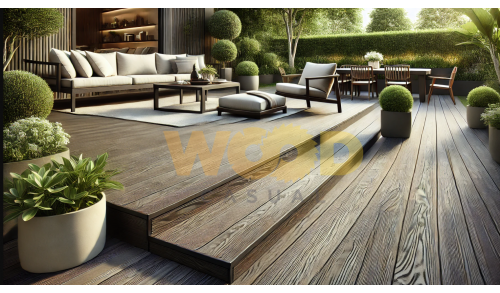
When choosing a material for a deck, it is important to consider not only the appearance, but also weather resistance, durability and ease of maintenance. One of the best solutions is thermo-ash decking. This material combines aesthetic appeal and excellent technical characteristics, making it increasingly popular among architects, designers and private developers.
What is Thermo Ash
Thermo Ash is ash wood that has undergone heat treatment at a temperature of 180-230 degrees without oxygen. During the treatment, the wood loses moisture, resins and sugars, which makes it biologically stable, durable and strong. What is Thermo Ash? It is natural wood, improved by modern technologies without the use of chemicals.
The treatment affects not only the strength characteristics, but also the appearance: the properties of Thermo Ash include a darker, richer shade, uniform texture and noble fiber structure. All this makes Thermo Ash especially attractive for finishing.
Thermally modified ash decking: advantages
Moving on to the topic of thermally modified ash decking advantages, it is worth highlighting several key points.
Stability of geometry. After heat treatment, wood loses up to 90% of its natural moisture. This means that the board does not warp, swell or shrink like ordinary wood.
Resistance to moisture and decay. Thermally modified ash is resistant to moisture and can be used in areas with high humidity - near swimming pools, on open terraces, in bathrooms and spa areas.
UV resistance. Due to its uniform structure, the material is less susceptible to fading. When treated with special oils, the color is preserved for years.
Environmental friendliness. No chemicals are used in the processing process - only heat, steam and pressure. This is a safe material for housing and the environment.
Premium aesthetics. The board has an expressive texture, the color varies from chocolate to amber. This thermally modified ash decking board fits perfectly into any architectural style - from Scandinavian to minimalism. Durability. The service life of thermally modified ash decking boards is from 25 to 35 years with proper installation and minimal maintenance.
Is thermally modified ash different from regular ash
Yes, and quite significantly. If we compare whether thermally modified ash differs from regular ash, then thermally modified ash:
is not afraid of water;
is not affected by insects;
does not crack from temperature changes;
is more stable in size.
Where to use thermo-ash
Terraces and balconies.
Swimming pool and garden path cladding.
Verandas, gazebos, summer kitchens.
Areas near water, moisture and temperature changes are not a problem for it.
Also - interior decoration of walls, ceilings, floors, especially in baths and saunas.
Pros and cons of thermo-ash
The pros and cons of thermo-ash can be described as follows.
Pros:
High strength and wear resistance.
Resistance to moisture, rot, fungus.
Aesthetic appearance.
Durability.
Safety and absence of chemicals.
Cons:
Higher cost compared to ordinary wood.
Care is required when cutting and installing (due to hardness).
It is recommended to protect with oil or special wax to preserve the color.
How to choose a quality decking board
If you are not sure how to choose a quality decking board, contact the manufacturer or a specialist. On our website https://woodcasual.com/en you can get advice and help in choosing a thermo-ash board for your project.
Thermo-ash decking board is a material for those who value quality, aesthetics and durability. Despite the higher cost compared to traditional species, it justifies itself in the long term. If you are looking for a “set and forget” solution, thermo-ash is your choice. It is climate-resistant, attractive in appearance and does not require complex maintenance. That is why thermo-ash decking board is becoming increasingly popular in the finishing materials market.
12/05/2025